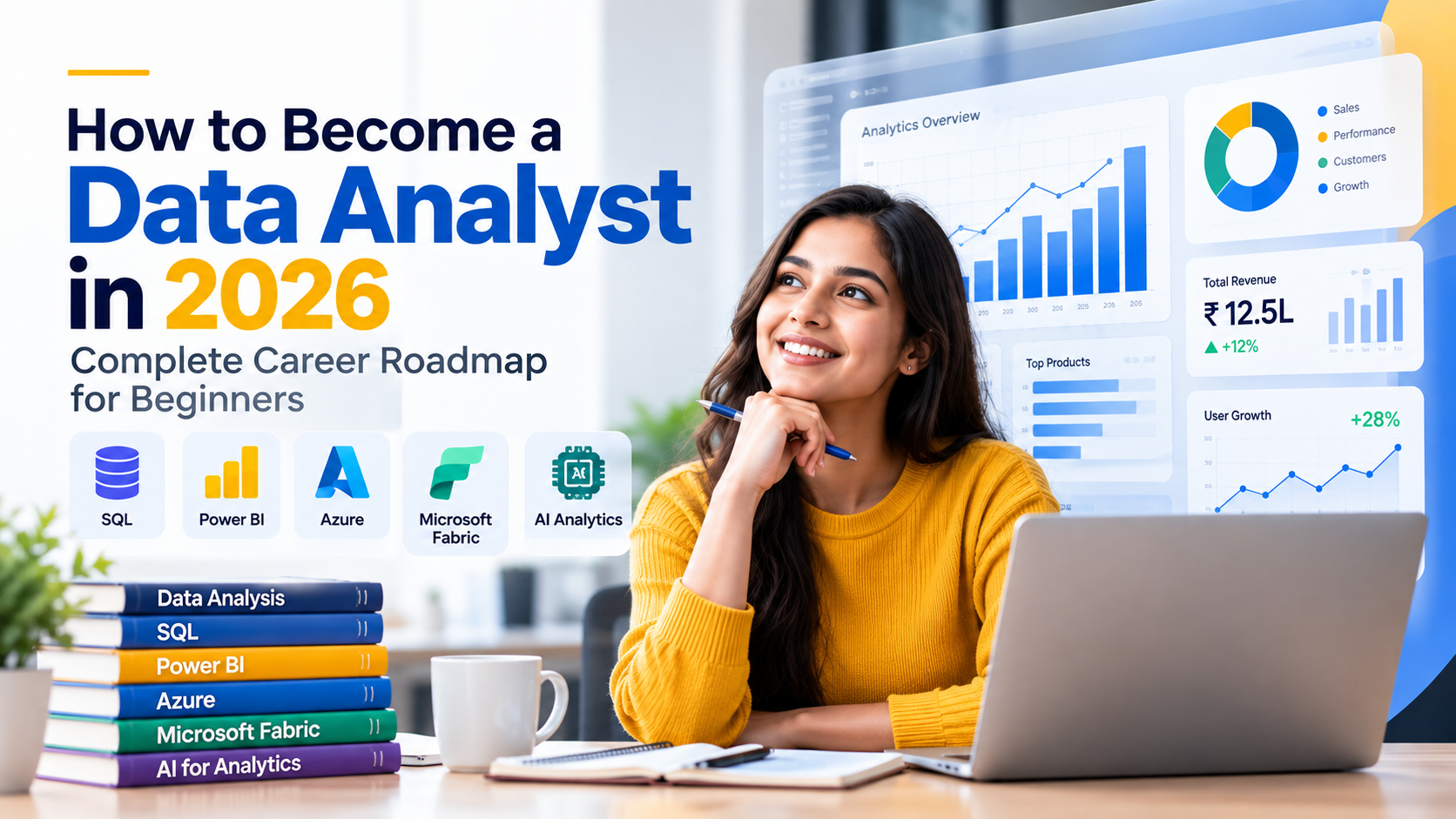
How to Become a Data Analyst in 2026: Complete Career Roadmap for Beginners
Data has become an important part of how businesses make decisions. Companies use data to understand customers, monitor performance, identify opportunities and improve business operations.
This has created opportunities for professionals who can transform raw data into useful business insights.
If you are a student, fresher, working professional or someone planning a career change, Data Analytics can be a practical technology career path to explore.
What Does a Data Analyst Do?
A Data Analyst works with data to answer business questions.
Typical responsibilities include:
- Collecting and organizing data
- Cleaning datasets
- Writing SQL queries
- Analyzing business performance
- Creating dashboards and reports
- Identifying trends and patterns
- Communicating insights to stakeholders
The goal is not simply to create reports. A Data Analyst helps organizations understand what is happening, why it is happening and what the data indicates.
Skills You Need to Learn
A beginner can build Data Analytics skills step by step.
1. Data Analytics Fundamentals
Start by understanding:
- Types of data
- Tables, rows and columns
- Databases
- Business KPIs
- Structured and unstructured data
- Basic data analysis concepts
Understanding the business context behind data is just as important as learning tools.
2. SQL
SQL is one of the core technologies used for working with databases.
Important concepts include:
- SELECT
- WHERE
- GROUP BY
- HAVING
- JOINs
- Subqueries
- CTEs
- Window functions
- Aggregate functions
Regular SQL practice can help you become comfortable with real-world data problems.
3. Power BI
Power BI can be used to transform data into interactive dashboards and reports.
You can learn:
- Data import
- Power Query
- Data cleaning
- Data modeling
- DAX
- KPIs
- Visualizations
- Dashboard design
4. Cloud and Modern Data Platforms
Modern analytics increasingly involves cloud technologies.
A learning roadmap can include:
- Microsoft Azure
- Azure SQL
- Azure Data Lake
- Data pipelines
- Microsoft Fabric
- Lakehouse concepts
KloudAI’s current Data Analytics curriculum includes SQL, Power BI, Azure and Microsoft Fabric, along with data modeling and AI-enabled analytics.
Build Real Projects
Learning tools is only one part of becoming a Data Analyst.
You should also build projects such as:
Sales Dashboard
Analyze:
- Revenue
- Products
- Regions
- Monthly sales
- Customer performance
Customer Analytics
Analyze:
- Customer purchases
- Purchase frequency
- Customer segments
- Revenue contribution
Business Performance Dashboard
Combine multiple datasets and create an interactive dashboard.
Projects help you demonstrate how you apply your technical knowledge to business problems.
What About AI?
AI is also becoming part of modern analytics workflows.
Data professionals can use AI tools to assist with:
- SQL query generation
- Data exploration
- Report creation
- Insight generation
- Data interpretation
KloudAI’s curriculum includes AI-enabled analytics, including Power BI Copilot, AI-generated SQL and tools such as Microsoft Copilot, ChatGPT and Azure OpenAI Service.
A Simple Learning Roadmap
You can structure your learning journey like this:
Month 1
Data fundamentals + SQL basics
Month 2
Advanced SQL + data modeling
Month 3
Power BI + dashboards
Month 4
Azure + Microsoft Fabric + real-world project
After the core training
Resume + portfolio + interview preparation
KloudAI describes its current program as a four-month, practical and industry-focused Data Analyst program with real-time projects and placement assistance.
Final Thoughts
You don’t need to learn every data technology at once.
Start with the fundamentals, become comfortable with SQL, learn a visualization platform such as Power BI, understand modern cloud data platforms and continuously build projects.
The most important goal is to move from learning concepts → solving problems → building projects → demonstrating your skills.
Interested in learning Data Analytics in Bhilai? Explore KloudAI’s Data Analytics programs and career support.